
Lighting Up The Helwick Light Vessel Number 91
Lighting Up The Helwick – Light Vessel No. 91
Bringing New Light to a Maritime Icon
Gavin Electrical Engineering is delighted to announce the successful completion of a bespoke LED lighting installation on the historic Helwick Light Vessel No. 91. Moored at the south entrance to the National Waterfront Museum in Swansea, this iconic ship now shines anew, celebrating both its rich maritime legacy and its role as a centrepiece of the city’s waterfront.
Project Background
The Helwick, decommissioned in 1977, has long stood as a silent sentinel, reminding visitors of the vital role light vessels played in keeping mariners safe around the UK’s treacherous coasts. As part of ongoing efforts to preserve and enhance the ship for future generations, Swansea Museum commissioned a sympathetic yet modern lighting solution to highlight the vessel’s unique features and ensure it remains a focal point after dark.
Our Approach
Understanding the importance of both heritage preservation and modern efficiency, our team designed a lighting scheme that is both visually striking and energy efficient. Every aspect of the installation was carefully planned to respect the vessel’s historic structure, with all works carried out in close consultation with museum staff and heritage advisors.
Key elements of the installation included:
- Power Supply: We established a dedicated supply from the local pontoon bollard, ensuring a safe and reliable source of electricity without impacting the ship’s original systems.
- Distribution Board: A new distribution board was installed within the ship, providing a central hub for all lighting circuits and future-proofing the installation for potential upgrades.
- Cabling: Outgoing SY cabling was used for the lighting circuits, chosen for its durability and suitability for marine environments. All external cabling was protected with soft duct, outdoor-rated covers to withstand the challenging waterfront conditions.
- Automated Control: A Sangamo Q553 timeclock was fitted, allowing the lighting to operate automatically each evening, seven days a week, until 11:00pm. This ensures the ship is always beautifully illuminated for visitors, while minimising energy use.
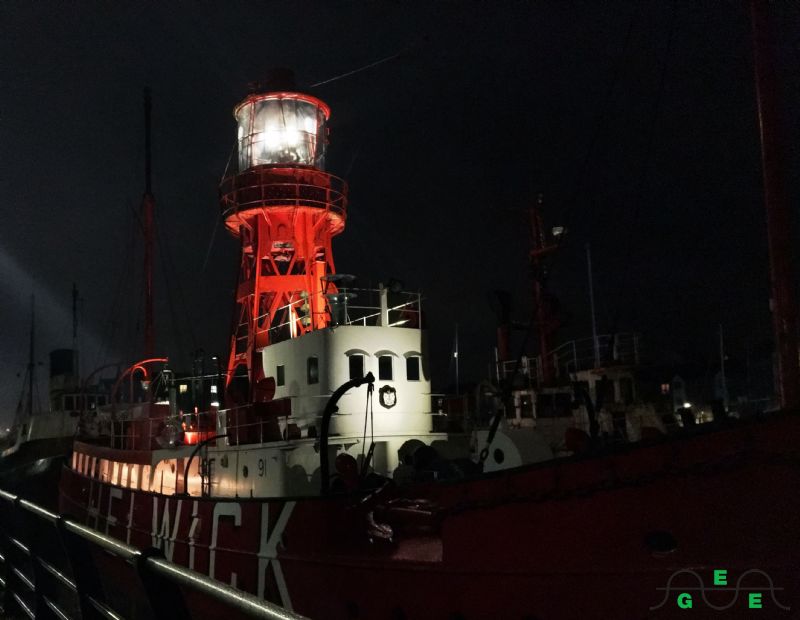
- Lighting Fixtures: We selected Robus Remy IP65 floodlights and Robus Duet outdoor spotlights for their reliability and ability to create dramatic up-lighting effects. Clear, outdoor-rated rope lighting was also installed to trace the ship’s lines and enhance its silhouette.
- Special Effects: To pay homage to the vessel’s original function, a Kemo M114N flasher module with adjustable sequence was installed to control the lighting tower, echoing the ship’s historic lamp sequence and adding a dynamic element to the display.
Overcoming Challenges
Working on a historic vessel presents unique challenges. Our team took great care to avoid any damage to the ship’s fabric, using non-invasive mounting techniques and routing cabling through existing channels wherever possible. All works were completed in accordance with best practice for heritage sites, ensuring the installation is fully reversible should future conservation needs arise.
Community and Heritage Impact
The new lighting scheme has transformed the Helwick into a true landmark on Swansea’s waterfront, drawing the eye of passers-by and providing a stunning backdrop for evening events at the National Waterfront Museum. The project has been warmly received by the local community, museum visitors, and maritime heritage enthusiasts alike.
A Glimpse into History: Light Vessel No. 91
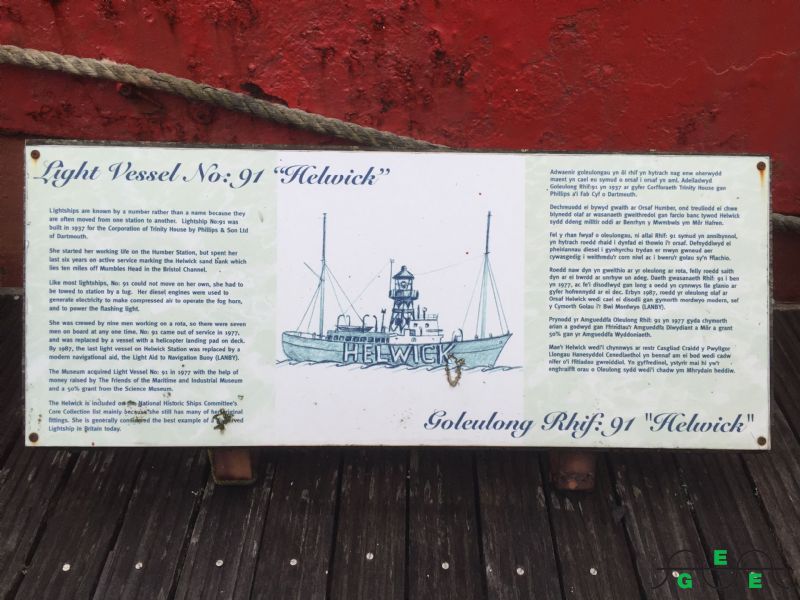
Built in 1937 by Philip and Son Ltd. of Dartmouth for Trinity House, Light Vessel No. 91 served at several key stations around the UK coast. Her first posting was the Humber, where she operated from 1937 to 1942, surviving two collisions during the Second World War. She later served at the Helwick station, off Worm’s Head, from 1971 until her retirement in 1977.
Unlike most ships, LV 91 is not self-propelled and was towed to each station by tug. Her diesel engines powered both the light—eight 110-volt, 375-watt lamps producing 650,000 candlepower—and the fog horn, which operated at 35 psi and sounded a distinctive three-second blast every thirty seconds. The vessel’s crew, comprising two masters and nine men, rotated on a four-week cycle, with seven on board at any time. Due to her deck layout, all crew changes were made by boat, as there was no space for a helicopter landing platform.
After her decommissioning, LV 91 was acquired by Swansea Museum in 1977, thanks to a 50% grant from the Science Museum and fundraising by the Friends of the Maritime and Industrial Museum.
Lighting the Way Forward
Our work on the Helwick Light Vessel No. 91 is more than just a technical achievement—it’s a celebration of British maritime history and a gift to the Swansea community. By combining modern technology with a deep respect for heritage, we have ensured that this remarkable vessel continues to inspire, educate, and delight all who visit the National Waterfront Museum.
We are proud to play a part in preserving the legacy of the Helwick and look forward to seeing her light up the Swansea skyline for many years to come.
Source: David Jenkins, Advisory Committee, March 2009. Published by Swansea Maritime Museum.
 Kemo flasher controlled Lighting tower
 4K lighting
 A side view of the Hellwick by day.
 The Hellwick all lit up at night.
 The history of the Hellwick


